ACM Multimedia 2026 Workshop and Grand Challenge
NeuroMM treats EEG, ECG, EMG, and wearable biosignals as first-class multimedia modalities and advances cross-modal reasoning with synchronized video, audio, and contextual streams.
Latest updates for the workshop and challenge.
Multimedia research has traditionally focused on external perception modalities such as images, video, audio, and language. In contrast, neurophysiological signals, including electroencephalography (EEG), electrocardiography (ECG), electromyography (EMG), and wearable biosensors, encode internal human states related to cognition, attention, emotion, and neural dynamics.
NeuroMM 2026 bridges this divide by introducing Multimodal Neurophysiological Intelligence, a unified computational framework that synergizes heterogeneous physiological signals with synchronized multimedia streams. This approach treats physiological sensing not as a niche medical modality, but as a core extension of multimedia computing for joint reasoning over internal and external human states.
Unlike traditional biomedical workshops, NeuroMM centers on multimedia-driven neurophysiological reasoning. Beyond our core focus on epilepsy detection, we aim to establish an ongoing ecosystem covering seizure prediction, mental health assessment, sleep analysis, and cardiac monitoring, providing shared tasks, datasets, and evaluation protocols for trustworthy multimodal neuro-intelligence.
We invite original submissions on multimodal neurophysiological intelligence for human-aware multimedia.
We invite researchers and practitioners to submit original papers aligned with the workshop's theme. Submissions can include methodological advancements, system designs, new benchmark datasets, and clinical applications.
Interictal Epileptiform Discharge Detection and Localization in Multimodal Neuro-Signals
NeuroMM 2026 reframes epilepsy analysis as multimodal reasoning by integrating EEG-centered physiological data with synchronized contextual information. The challenge is built on vEpiSet, a clinically grounded benchmark collected under standardized protocols at Peking Union Medical College Hospital.
Dataset Highlights: 84 subjects (52 epilepsy, 32 control), 20-minute recordings per subject, and 25,449 four-second epochs with expert-reviewed labels.
Timeline: The challenge starts at 16:00 GMT on May 20, 2026 and closes at 16:00 GMT on Jun 11, 2026. Beijing Time is used as the original reference for the competition schedule.
Teams may participate in one or multiple tracks according to their interests and research directions.
Timeline view with year navigation.
Jul, 2025
Project officially initiated.
Sep, 2025
Data preparation and organization.
Dec, 2025
Proposal drafting period.
May 1, 2026
Workshop submission system opens.
May 20, 2026, 16:00 GMT
Challenge begins. May 21, 2026, 00:00 (Beijing Time)
Jun 11, 2026, 16:00 GMT
Challenge ends. Jun 11, 2026, 24:00 (Beijing Time)
Jun 25, 2026
Grand Challenge Papers submission deadline.
Jul 16, 2026
Grand Challenge Papers acceptance notification.
Jul 17, 2026
Workshop paper submission deadline.
Aug 1, 2026
Camera-ready paper deadline.
(All deadlines are at 11:59 PM GMT)
General Inquiries: contact@neuromm.org
Workshop Collaborations: Fei Ma (Email: mafei@gml.ac.cn; WeChat: feima0969)
Challenge & Registration: Zebang Cheng (Email: zebang.cheng@gmail.com; WeChat: ZebangCheng)
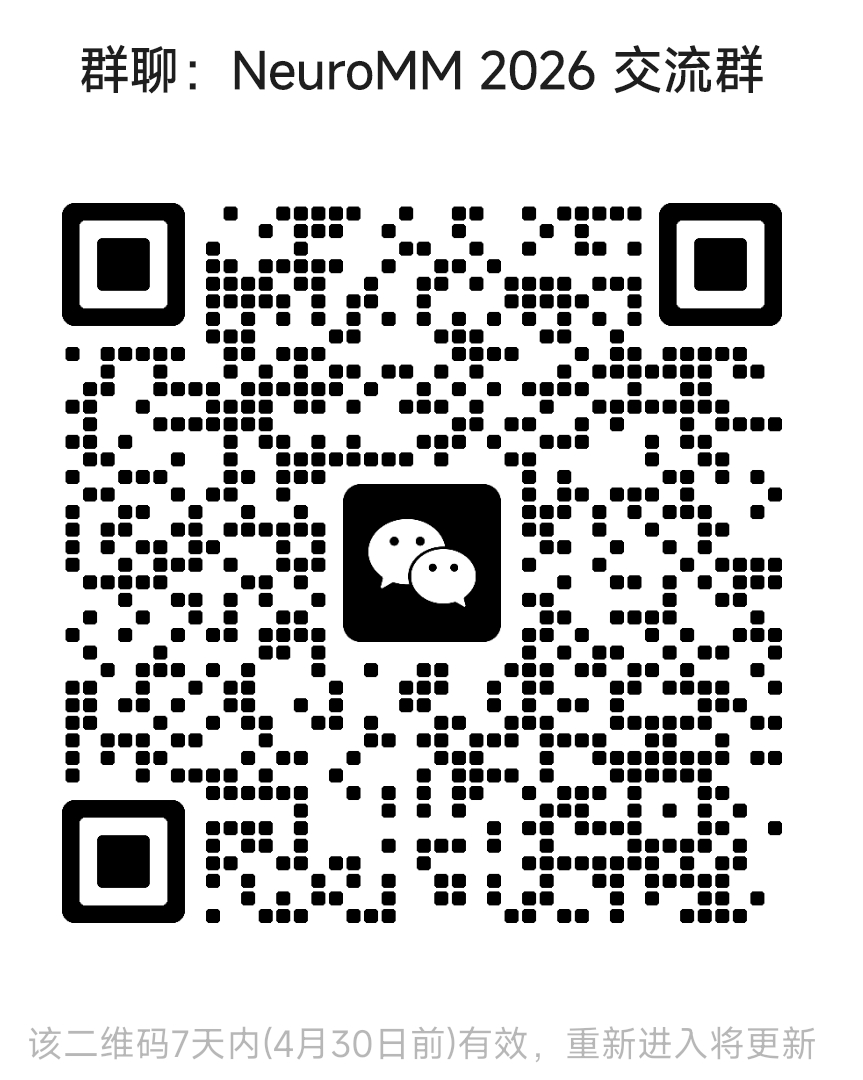
Welcome to join the official NeuroMM 2026 WeChat group for communication.